Insights

How Much is Beauty Therapist Insurance?

How Much is Beauty Therapist Insurance? 1000 667 James Hallam

Specialist insurance can cover beauticians, makeup artists, nail technicians, hairdressers, and other professionals from the unique risks associated with providing beauty therapist services.

In this post we will take a quick look at the sort of insurance beauty therapists need, before exploring the factors that can affect how much you pay for your specialist cover.

What Type Of Insurance Do Beauty Therapists Need?

As a beauty therapist, you will need cover for:

  • Your specialist equipment
  • Liability cover just in case a customer ever makes a claim against you
  • Your business premises, to cover you for losses from fire, flood, or theft, if you run your own beauty establishment
  • Treatment risk insurance, depending on the type of services you provide. If you accidentally injure a customer during a procedure, or if they experience an allergic reaction to a product you use, this can cover any legal fees or compensation payments that may arise.
  • Employer’s liability insurance, which you have a legal duty to get if you employ any staff. This will cover your employees for any accidents or injuries they may experience while working for you.

You can read our full guide to insurance for beauty therapists.

How Much is Beauty Therapist Insurance?

The minimum insurers charge for very basic cover is around £5 – £8 a month for beauty therapist insurance. Though the amount you pay for your cover can vary greatly depending on a number of factors.

What Can Affect The Cost Of Beauty Therapist Insurance?

  • The Type of Beautician Services You Offer – If you provide highly specialist services, such as microplanning, dermaplaning, and other more intensive procedures, then you may need treatment risk insurance. This will likely cost you more than a standard business insurance policy.
  • The Type of Business You Run – Many factors can increase the cost of your cover, including the number of employees you hire, and the size and location of your beauticians premises, if you have one. On the other hand, you will likely pay less for cover if you are an independent beautician and you visit clients on their premises to provide your services.
  • The Level of Cover You Get – When you take out a policy, you may have a choice in the amount of liability cover you get. This can determine the overall price of your policy.

How Can I Reduce The Cost of Beauty Therapist Insurance?

You can make a saving on the cost of your insurance through only taking out the bare minimum of cover. However, this could prove risky. If you ever need to make a claim on your policy, you might find that your insurance will not cover you for your losses.

It is much better to have the cover you need than it is to risk underinsurance. As a result, the best way to save money on your policy is through working with an insurance broker.

James Hallam is an independent Lloyd’s broker with a dedicated team of experienced insurance professionals who care about protecting your beautician business. We will take the time to get to know you and the services you provide. We can then help you access the specialist, tailored cover you need at a competitive price.

Find out how we can help you with your beauty therapy insurance today.

What Insurance Do I Need for an Airbnb?

What Insurance Do I Need for an Airbnb? 1000 665 James Hallam

You will need specialist host liability insurance if you want to let out your property on Airbnb. In this post, we’ll be looking at what you need specialist insurance, why insurance you need and why could happen if you find you’re not covered.

Who Needs Insurance for an Airbnb?

You will need a dedicated policy whether you let:

  • A single room in your home, or an annex
  • The entirety of a property, such as a second home or a holiday home
  • A smaller structure on your property, such as a shepherd’s hut, a glamping pod, or similar

Why Do You Need Specialist Insurance for an Airbnb?

A standard home insurance policy will not cover you if you let your property to paying guests using Airbnb. This is because there are numerous unique risks associated with letting members of the public stay on your property as paid guests, none of which will be included in your home insurance policy.

These risks include:

  • Guests injuring themselves while staying on your property.
  • Guests causing accidental damage, or even intentional malicious damage, whether to your property or any nearby properties or common areas.
  • A guest damaging or losing their own property while staying on your property.
  • A guest compromising your home security system (such as through accidentally leaving a door unlocked), resulting in theft or vandalism.

What Insurance Do You Need For an Airbnb?

If you want to let your property on Airbnb, you will need:

  • Host Liability Insurance – This will cover you for any claims that may arise for loss, damage, or injuries guests experience while staying on your property. It can also cover damage caused by guests to other properties or common areas near your property.
  • Host Damage Protection – This can cover any damages that guests cause to your own property or belongings. It can also cover instances of theft, whether a guest steals from your property, or they accidentally leave a door unlocked, making your property vulnerable to thieves.
  • Second Home or Holiday Home Insurance – If you list a second home or a holiday home on Airbnb, a dedicated insurance policy can cover it for any leaks, fires, break-ins, or other incidents that occur while your property is unoccupied. Please note that a standard home insurance policy will not provide any cover if the property is unoccupied for extended periods.

What Happens If You Do Not Get Insurance For Your Airbnb?

Airbnb may require you to get some form of cover in place before you can list your property on their site. Beyond this, you have no legal obligation to get host liability insurance. However, if you do not get sufficient cover, you may face extensive costs, and even some legal difficulties, should something go wrong while a guest is staying at your property.

A guest could trip over a rug, or a wire, or a loose bit of carpet. They could injure themselves, or they could drop the expensive laptop they happened to be carrying at the time.

In either case, as the accident happened on your property, you may be held liable for their injury, or for the damage to their property. So, if the guest makes a claim against you, you could be responsible for covering all legal fees along with any compensation payments that may arise.

Also, as we pointed out above, a standard home insurance policy will not cover your property if it is left unoccupied for extended periods. And when a property is unoccupied, it is more vulnerable to vandalism and burglary, and small issues can quickly spiral into major disasters. For example, over time, even a small leak could result in severe water damage.

We Can Help You Get The Insurance You Need For Your Airbnb

If you want to let part of your property, or your full property on Airbnb, we are here to help.

We can help you understand the unique risks you face, and we can advise you on how to manage and mitigate these risks. We can then help you access the specialist insurance you need to cover your property on Airbnb, including host liability insurance, host damage protection, and comprehensive second home or holiday home insurance.

Find out how we can help you with Airbnb insurance today.

What is Social Engineering in Cyber Security? And How To Protect From It

What is Social Engineering in Cyber Security? And How To Protect From It 1000 653 James Hallam

In this post we will explain how social engineering attacks work, and discuss how you can protect your systems against this form of cybercrime.

What is Social Engineering?

Social engineering is a type of cyberattack that relies on the psychology of persuasion to trick people into divulging personal information, or accessing malicious links or attachments.

How Does Social Engineering Work?

Many social engineering attacks start with a cybercriminal communicating directly with their intended target. This might be via an email, a text message, or a telephone call.

The cybercriminal will pretend to be from a trusted organisation, or they may even attempt to impersonate a specific person, such as a manager or an IT consultant. In any case, the aim is to trick the target into taking an intended action. This could be to divulge sensitive information, such as bank details or a password, or to click on a malicious link, or to open a malicious email attachment.

What Happens If You Fall Victim to a Social Engineering Attack?

If someone falls for a social engineering attack, then they may themselves become victims of identity theft or other forms of fraud. But in most cases, the cybercriminal’s aim is to breach a secure system. They may target an employee of a company, for example, in order to access the company’s systems or data. Or they may try to gain entry to an employee’s computer in order to hit the whole company with a ransomware attack.

This is why social engineering attacks can be so dangerous. Cybercriminals can target multiple people in an organisation at the same time. And in order for their attack to be successful, it only needs to work against one person.

The Different Types of Social Engineering Attacks

  • Phishing – This involves sending a message, such as an email, that claims to be from a trusted individual or organisation. The aim is to trick the recipient into divulging sensitive information, or to take some other desired action, such as clicking a link or opening an attachment.
  • Baiting – This might also be referred to as a “watering hole attack”. It involves setting up a fake, malicious website that looks identical to a trusted organisation’s website. Of course, entering your login information on this fake website essentially means that you are sharing your username and password directly with cybercriminals.
  • Physical Social Engineering Attacks – Some social engineering attacks may be more personal. You might get a phone call, apparently from your bank, urging you to share certain information so as to correct some kind of bank error. Or, a cybercriminal may post as an IT support worker, in order to gain direct access to a system.

How To Protect Yourself, Your Employees, and Your Business Against Social Engineering

Social engineering attacks are particularly dangerous as they target the weakest link in any cybersecurity system – people. This means that even the most advanced of cybersecurity systems can still be vulnerable to a social engineering attack.

And as cybercriminals are getting smarter and more sophisticated all the time, even the savviest and most experienced of IT professionals may still fall victim to a social engineering ploy.

Constant vigilance is your best defence against social engineering, underpinned by a robust IT security framework.

Essential Cybersecurity Measures Against Social Engineering Attacks

  • Staff Training – It is essential that you, and everyone else in your business, understands the risks, and the red flags that could suggest that a message or phone call is not what it seems. This training should be tailored to reflect the unique risks that might exist for your organisation, and the specific forms of attack that cybercriminals may attempt to gain access to your system.
  • Password Management – Set clear guidelines on password security, including procedures for when employees should update their passwords, and a strict rule that employees must not share passwords with anyone, at any time.
  • Multi–Factor Authentication – This means that people will need more than one security credential in order to access a system. For instance, employees may have to provide one-time passcodes, as well as biometric information, in addition to their passwords.
  • Zero Trust Security – This is a cybersecurity framework whereby every user must provide credentials at every point of access, without exception. This, combined with multi-factor authentication, will make it much harder for cybercriminals to access your system, even if their social engineering attacks are successful.

How to Respond To Social Engineering Attacks

Your cybersecurity policy should also outline how you respond to a social engineering attack.

Employees should know who to report to, and what actions they should take, if they suspect they have fallen victim to an attack. This might involve changing their passwords or notifying IT staff, who may be able to take appropriate action before it is too late.

This is one area where cyber insurance can make a huge difference. As well as covering your liabilities during a cyberattack, cyber insurance can also cover certain expenses associated with your response, including the costs of notifying clients or customers whose data may have been compromised by a breach.

Read our full guide to how cyber insurance can help protect your business.

Get Tailored Cyber Insurance For Your Business

James Hallam is an independent Lloyd’s broker with access to a hand-picked selection of A-rated insurance providers. We can help you find the cyber insurance you need at the best possible price.

Get in touch for a free quote today.

What is DDP and DAP in Shipping?

What is DDP and DAP in Shipping? 1000 750 James Hallam

International commercial terms (incoterms) are a set of standard trade definitions that outline the specific responsibilities of buyers and sellers in international trade agreements. You can read our full guide to incoterms.

In this post we will take a closer look at two specific incoterms: DDP and DAP. We will explore the key differences between these two terms, and outline how they might affect your risks, responsibilities, and costs in an international shipping agreement.

DDP and DAP – A Brief Introduction

DDP (Delivered Duty Paid) and DAP (Delivered at Place) are both seller-focused incoterms. These terms apply to transactions where the seller, exporter, or manufacturer takes on most or all of the costs and risks associated with delivering goods to a named place of destination.

What is DDP in Shipping?

The DDP (Delivered Duty paid) incoterm places maximum responsibility on the seller.

Under a DDP contract, the seller, exporter, or manufacturer takes full responsibility for delivering goods to the agreed destination. They will cover all associated costs and risks, which includes all relevant customs and duties. Typically, the seller will include all of these expenses in the price of their goods, which can result in clear and transparent costs for all parties involved.

In a DDP arrangement, the buyer’s only responsibilities involve unloading the goods once they reach their destination. So, while the buyer will likely have to pay a higher price for the shipping, DDP remains a popular choice for buyers who are new to international shipping, and for those who want a frictionless and streamlined approach to entering new markets.

What is DAP in Shipping?

The DAP (Delivered at Place) incoterm is similar to the DDP incoterm, in that the seller is responsible for delivering goods to an agreed destination, covering all transport costs and bearing all risks until the goods reach their destination port.

The key difference between DAP and DDP is that, in a DAP arrangement, the seller does not take responsibility for covering any customs, taxes, and duties that may arise during the shipping process. Instead, the buyer will take responsibility for covering these costs. The seller generally will not include these charges in the total costs of their goods, meaning that the buyer will have less clarity and transparency when it comes to the total cost of the shipping.

However, the buyer will have full control over all import procedures, which often makes DAP the preferred arrangement for companies with pre-existing relationships with customs brokers, or for larger companies with established logistics expertise.

Is DDP or DAP Better For Sellers?

If you are a seller, you will have extensive responsibilities and liabilities regardless of whether you choose DDP or DAP. These will include:

  • Preparing and packaging all goods for shipping.
  • Arranging for shipping to the specified destination.
  • Bearing all costs and all risks until the point the goods arrive at their destination – including all marine insurance costs.
  • Providing all necessary documentation for customs and so on.

The only difference is that, with DDP, you will have to cover all customs, taxes, and duties on top of this.

If you would prefer an arrangement in which the buyer takes on more risks, or in which the buyer and the seller share the risks and the costs, read our complete guide to incoterms.

DDP or DAP – Which is Best For Buyers?

If you are a buyer, choose DDP if:

  • You are inexperienced with international shipping, or you are looking to enter a new market, and you are happy for the seller to take care of everything.
  • You want total clarity and transparency with the price you pay for shipping. In most cases, the price the seller quotes for shipping will include everything, including the costs of customs, taxes, duties, and insurance cover.

However, you might prefer DAP if:

  • You want flexibility with your transport options. DAP arrangements are compatible with all forms of transport, including air, rail, road, and sea.
  • You have established relationships with customs brokers, or you have in-house logistics expertise, so you would prefer to handle all customs, duties, and tax procedures yourself.

One more thing to consider: Choosing either DDP or DAP will tie you to your seller’s price structure and supply chain. For one reason or another, this might not suit your needs. Alternative incoterm arrangements would give you greater flexibility, but most would require you to take on additional costs, risks, and liabilities.

For more information, read our full guide to incoterms.

How DDP and DAP Affect Insurance in Shipping

The incoterms you use during your transactions will determine the level of insurance cover you need, whether you are the buyer or the seller.

In both DDP and DAP transactions, the seller takes on the most risk. The responsibilities only transfer from the seller to the buyer at the point of delivery, at which point the buyer is responsible for ensuring all goods are safely unloaded.

Whichever code you use, and whichever party you are in the transaction, it is essential that your insurance covers you for all the risks and responsibilities as outlined in your contract.

Everard Insurance Brokers are the specialist marine trading division of accredited Lloyd’s brokers James Hallam Limited. We can help you understand the cost, risk, and insurance implications of any incoterm you use, and we can help you get the specialist cover you need at a competitive price.

Find out more about our dedicated marine insurance services, or call us on 020 3148 9540 or email info@everardinsurance.co.uk.

How Many Shipping Containers Are Lost At Sea Each Year?

How Many Shipping Containers Are Lost At Sea Each Year? 800 533 James Hallam

Hundreds, and sometimes thousands, of shipping containers are lost at sea each year, resulting in significant financial losses for global shipping businesses. Lost containers can also present a collision risk for other vessels at sea, and depending on their contents, they could even lead to serious environmental damage.

In this post we will explore why so many shipping containers get lost at sea each year, and discuss how you can best protect your shipping business against financial loss.

How Many Shipping Containers Get Lost At Sea Every Year?

The World Shipping Council routinely surveys its member companies in order to estimate the number of shipping containers that get lost at sea each year.

The most recent survey, from 2025, covers the years up to and including 2024. Here are the total number of containers lost at sea over the past few years, according to World Shipping Council members:

  • 2024 – 576
  • 2023 – 221
  • 2022 – 661
  • 2021 – 2,301
  • 2020 – 3,924

The World Shipping Council points out that over 250 million containers are shipped each year. 576 lost containers equate to just 0.0002% of this total. They also highlight how approximately 33% of all containers lost each year are ultimately recovered.

The World Shipping Council has been surveying their members in this way since 2011. Each year, they report a rolling three-year average. In the latest report, this stood at 489. In the previous report, the rolling three-year average was more than double this, at 1,061.

So, there is an encouraging downward trend. But the council also report a 10-year average of 1,274 containers lost each year. Every single lost container will lead to significant expenses, and each one poses a hazard to other vessels, and potentially to the environment too.

What Causes Shipping Container Loss?

Container falls
A container might fall from a vessel as a result of bad weather, collisions, or other incidents at sea. Human error can also play a part, should someone fail to correctly secure a container, for example. A ship may also choose to jettison its cargo in response to an onboard incident, such as a fire.

Global events
Global events can influence the total number of containers lost in a year. In recent years, unrest in the Middle East has forced many shipping routes to detour away from the Red Sea, and around the Cape of Good Hope.

Converging weather systems make extreme weather events, along with steep wave patterns, relatively common in this area. According to the South African Maritime Safety Authority, around 200 containers were recently lost around the Cape of Good Hope in the space of one year.

Isolated events
Occasionally, isolated events cause a major spike in the number of shipping containers lost in one year. 5,578 containers were lost in 2013, making this the worst year for losses in recent memory. This was largely due to a single incident in which an entire vessel was lost. Large scale incidents also occurred in 2020, when 3,924 containers were lost in a year, and 2021, which saw total losses of 2,301.

TopTier is an ongoing research project which is currently investigating these large scale losses in order to determine what went wrong, in the hope of identifying potential actions that could help prevent container loss.

Who is Liable For Shipping Container Loss?

Claims involving lost containers can get complicated. As well as the physical loss of the container, insurers must also consider any other containers that get damaged as a result of collapsing stacks, along with any damage the vessel itself sustains during the incident. Plus, as we mentioned above, a container lost at sea could ultimately damage other vessels, and could also have an environmental impact.

A shipping contract should outline who is responsible for costs and losses at each stage of the process. Whichever party is responsible for the goods during the passage at sea, whether that is the buyer or the seller, will have to ensure they are fully covered for potential container losses, along with the subsequent damages and costs that may arise.

Beyond this, the specific circumstances of the incident will determine who takes ownership of the container after it is lost. The cost of recovering lost containers, for instance, often falls on third parties. You can read our full guide to the different types of marine insurance loss claims.

Get Comprehensive Marine Insurance From James Hallam

Everard Insurance Brokers are the specialist marine trading division of James Hallam Limited who are accredited Lloyd’s brokers.

We can help you understand your liability concerning incidents of containers lost at sea, and we can help you ensure you have the dedicated insurance you need to cover you for all risks.

Find out more about our specialist marine insurance services. Or to speak to one of our team Call us on 020 3148 9540 or email info@everardinsurance.co.uk

Incoterms: Full List with Meanings & Definitions

Incoterms: Full List with Meanings & Definitions 800 533 James Hallam

If you want to ship goods internationally, it is essential that you understand incoterms.

In this post we will outline the full list of incoterms, with meanings and definitions, before exploring why they matter.

What are Incoterms?

Incoterm is short for “international commercial terms”. These are a set of standard trade definitions introduced by the International Chamber of Commerce to transcend global language barriers.

Each incoterm features three letters, and each outlines the specific responsibilities of buyers and sellers in international trade agreements.

Because banks and customs agencies across the world use the same incoterms, anyone involved in international shipping can avoid ambiguities.

Some incoterms apply to all modes of transport, while others are exclusively for sea and inland waterway transport.

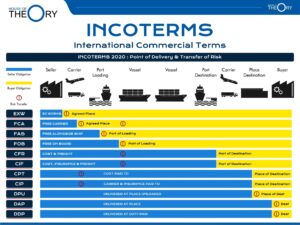
Full List of Incoterms

The current edition of incoterms is INCO 2020. There are 11 incoterms in total, and they are grouped into four categories:

The E Term

EXW

EXW is the only E term. It stands for “Ex Works”.

This term is used exclusively to refer to transactions where the seller, exporter, or manufacturer makes the goods available at their own premises. This means that the buyer takes on all subsequent risks, responsibilities, and costs for the goods’ ongoing journey to the final point of delivery.

The F Terms

These terms apply to transactions where the seller or exporter is responsible to deliver the goods to a carrier.

Usually, the buyer arranges for the carrier, meaning that the buyer and the seller share risks and costs. The seller handles the risks and costs up to the handover, and the buyer handles the risks and costs for the rest of the process.

There are three F terms:

FCA (Free carrier)
The delivery point is an agreed location, such as a port or a terminal.

FAS (Free Alongside Ship)
This term refers exclusively to marine shipping. The delivery point is a port of shipment, and the risk and cost transfer takes place when the goods are placed alongside the ship.

FOB (Free On Board)
Another marine shipping incoterm. Like FAS, the delivery point is a port of shipment, but this time the risk and cost of transfer takes place when the goods are loaded onboard the ship.

The C Terms

These terms apply to transactions where the seller, exporter, or manufacturer takes responsibility for arranging for, and paying for, the carriage of goods. However, they are not responsible for any additional risks or costs that may emerge once the goods have been shipped.

There are four C terms:

CPT (Carriage Paid To)

The delivery point is a named place of destination, and the seller is responsible for all transport costs until the goods are handed to the first carrier.

CIP (Carriage and Insurance Paid To)

The delivery point is a named place of destination, and the seller is responsible for all risks and costs until the goods are handed to the first carrier. In this case, the costs include some insurance cover for any loss or damage to the goods during that first part of their journey.

CFR (Cost and freight)

This term refers exclusively to marine shipping. The delivery point is the port of destination, and the seller is responsible for all freight costs up to the point where the goods are onboard the ship.

CIF (Cost, Insurance, and Freight)

Another marine shipping term. The delivery point is the port of destination, and the seller is responsible for all freight costs up to the point where the goods are onboard the ship. But they will also pay for insurance, to cover any loss or damage to the goods during that first part of their journey.

The D Terms

These terms apply to transactions where the seller, exporter, or manufacturer takes responsibility for all costs and risks associated with delivering goods to a named place of destination.

There are three D terms:

DAP (Delivered At Place)

The buyer specifies a delivery point, and the seller is responsible for all costs and risks associated with delivering the goods to this destination. However, this does not extend to any costs or risks associated with unloading the goods, or taking them to a further destination.

DPU (Delivered At Place, Unloaded)

The buyer specifies a delivery point, and the seller is responsible for all costs and risks associated with delivering the goods to this destination. This time, the seller takes additional responsibilities for the costs and risks associated with unloading the goods at the destination.

DDP (Delivered Duty Paid)

The buyer specifies a delivery point, and the seller is responsible for all costs and risks associated with delivering the goods to this destination. In this case, these costs will include any duties incurred during the delivery.
Why Incoterms Matter for Liability

Each incoterm clarifies both the buyer’s and the seller’s responsibilities when it comes to both costs and risks. The terms also clarify the limits of these responsibilities, and the point at which they might transfer from one party to another.

Get incoterms right, and it can lead to streamlined global shipping, even when there is no shared language. But get them wrong, and it can lead to delays, extra costs, custom issues, and even legal disputes.

This is why it is important to not just choose the right incoterm for each transaction, but also to ensure that the contract reflects the implications of the term you use. For example, most incoterms require a named destination. If this is not included in the contract, it could lead to ambiguities and disagreements should anything go wrong.

How Incoterms Affect Insurance

The incoterms you use during your transactions will also determine the level of insurance cover you need, whether you are the buyer or the seller.

In an EXW transaction, the buyer takes on the most risk. In a DDP transaction, the seller takes on the most risk. Other incoterms will require the buyer and the seller to share the risks and the costs, with the specific code determining the precise point at which the responsibilities transfer from one party to another.

Whichever code you use, it is essential that your insurance covers you for all the risks and responsibilities as outlined in your contract.

Everard Insurance Brokers are the specialist marine trading division of accredited Lloyd’s brokers James Hallam Limited. We can help you understand the cost, risk, and insurance implications of any incoterm you use, and we can help you get the specialist cover you need at a competitive price.

Find out more about our dedicated marine insurance services, or call us on 020 3148 9540 or email info@everardinsurance.co.uk.

Health and Safety Checklist For The Office

Health and Safety Checklist For The Office 800 533 James Hallam

Compared to a warehouse, a construction site, or a factory, an office might not feel like a particularly risky work environment. But accidents can still happen. And if they do, your business could face some costly claims.

Common Risks For Offices

It is important to take the time to understand all of the possible risks in your office that could lead to an accident or other incident. Once you understand these risks, you will know what actions you need to take to manage and mitigate them.

  • Slips, Trips, and Falls – Employees could trip over bags, files, wires, and other items that might clutter or obstruct walkways. A leak or spillage in the kitchen or breakroom could also lead to slips or falls.
  • Musculoskeletal Injuries – If an employee lifts a heavy item without following the correct procedures, it could lead to serious long-term back injuries. Years of bad posture could also result in chronic issues in later life.
  • Damage to Property – If an employee spills a cup of coffee at their desk, it could result in significant damages to your company’s property and equipment.
  • Fire, Flood, and Theft – Finally, offices must contend with the same risks that exist for any business in any sector. Fires may be a particular risk for offices, as the prevalence of flammable materials, including paper and soft furnishings, could mean that any fire that breaks out will rapidly spread.

How to Perform a Risk Assessment For Your Office

There are four essential steps to an office risk assessment:

  1. Identify every risk that could lead to accidents or injuries. As well as immediate risks, such as obstructions that could lead to trips or falls, also consider long-term risks, such as back problems arising from poor lifting techniques.
  2. Determine the likelihood and severity of every risk you identify. Also determine who each risk is most likely to affect. In an office environment, where everyone works similar jobs in similar conditions, it may be the case that every member of staff is equally susceptible to any risk you identify.
  3. Outline the steps you can take to manage, mitigate, or eliminate each risk you identify. Again, it pays to think of long-term risks as well as immediate risks. For example, what can you do today to prevent the onset of RSI in your employees’ later lives?
  4. Establish who is responsible for carrying out every risk management procedure you identify. For example, every employee might take responsibility for keeping the area immediately surrounding their desk free from clutter, to reduce the possibility of trips and other incidents.

Read our full guide to risk assessments for businesses.

Health and Safety Starts With Staff Training

You should routinely train your staff to understand the risks associated with the office environment, and the part they can play in managing these risks.

Along with managing everyday risks, your staff training should cover:

  • Safe lifting techniques – To avoid the musculoskeletal injuries that could arise from lifting a heavy object.
  • Fire safety procedures – What your staff should, and should not do, in the event of a fire. Read our full guide to fire safety procedures for businesses.
  • Cybersecurity – Your employees should also understand the role they can play in protecting your business from cybercrime. Read our essential introduction to cybersecurity for businesses.

All new employees should go through this training as part of their induction, and you should run refresher training sessions at least once a year.

Health and Safety Checklist For The Office

Beyond staff training, here are the key elements of health and safety that you should address in your office:

The workplace environment

  • Is there a cleaning rota, and are you sticking to it?
  • Are staff responsible for keeping their own work areas clean?
  • Are the walkways free from clutter and other trip hazards?
  • Also pay attention to the light levels, the noise levels, and the air quality in the office.

Fire safety

  • Are you keeping on top of routine safety inspections for the electrical equipment in your office?
  • Are your fire extinguishers in code?
  • Are your alarms and sprinkler systems working?
  • Make sure your fire escape routes are clearly marked, and free from all obstructions.

Accident reporting

In the event of an accident, you should:

  • Have a process for reporting what took place
  • Identify possible root causes of the incident.
  • Identify some possible actions you could take to prevent similar incidents from occurring in future.

Get The Right Cover For Your Office

You have a legal duty to get employer’s liability insurance. This will cover your employees for any accidents that might take place in the workplace.

But remember that anything that happens to your employees could also happen to visiting clients and customers, to contractors, to delivery drivers, and to other members of the public who may spend time on your premises.

You employer’s liability insurance would not cover any incidents involving non-employees. Nor would it cover damage to property, or other losses associated with fire, flood, theft, or cybercrime.

This is why you need specialist, comprehensive insurance for your office. James Hallam is an independent Lloyd’s broker with a dedicated team of experienced insurance professionals who care about protecting your business. We can help you get the dedicated cover you need for your office, at the best price.

Learn more about our specialist office insurance services, or for more information call us on 0330 024 0755 or email enterprisenb@jameshallam.co.uk


What Insurance Do Coworking Spaces Need?

What Insurance Do Coworking Spaces Need? 800 391 James Hallam

There are currently over 4,300 coworking spaces in the UK, with more opening each year.

Coworking spaces provide an affordable means for SMEs and startups to launch and scale, while also providing unique networking opportunities for freelancers, consultants, and other independent professionals.

But this new way of working creates new risks. If you own or manage a coworking space, in this post we will outline what insurance you will need to cover your coworking space, and the people that use it, against all risks.

Add Insurance Requirement To Your Membership Agreements

You should specify that anyone who joins your coworking space, whether they are an individual or an organisation, has adequate insurance to cover their own risks. This should be a requirement for all contracts, even if they only last for a few weeks.

Members’ insurance should cover:

  • Their own property. e. Any stock, equipment, devices, or other items they bring to the coworking space.
  • Their own liability. For example, any business that uses your coworking space should be covered for any accidents or incidents involving their own employees, or any clients they bring onto the premises.

This means that there will be less uncertainty surrounding who is liable for certain claims. But as well as requiring your members to take care of their own cover needs, you will need your own insurance to cover the areas of your operation for which you are personally liable.

Insurance Cover Coworking Spaces Need

In addition to requiring your members to hold their own insurance, as a coworking space, you’ll also need:

  • Employers liability insurance
  • Public liability insurance
  • Buildings insurance
  • Contents insurance
  • Business interruption insurance
  • Cyber Insurance

We’ll cover each of these in more detail below.

Employer’s Liability Insurance

If you employ any staff to manage your coworking space, then you have a legal duty to get employer’s liability insurance. This will cover your employees for any accidents or injuries they may experience while working for you.

This cover could extend to:

  • Cleaning staff
  • Caretakers and maintenance staff
  • Onsite tech support
  • Receptionists
  • Catering staff

Public Liability Insurance

Your members should get liability insurance to cover their employees, and any other individuals they bring to your coworking space. But you should still get your own public liability insurance to cover any other members of the public who may visit your premises.

This could include:

  • Contractors
  • Delivery drivers
  • Prospective clients, who visit your coworking space to see if it is right for them

Public liability insurance will cover these individuals for any accidents or injuries they experience while spending time at your coworking space. This will also include cover for their personal property.

Buildings Insurance

This will cover the structure of your coworking space, including any interior fixtures and fittings such as doors, staircases, elevators, and so on. It may also cover certain exterior features, such as car parks, gardens, and outdoor structures.

You will likely be required to get buildings cover for your coworking space as a condition of your rental or mortgage agreement.

Contents Insurance

As we mentioned above, you should specify that anyone who uses your coworking space takes responsibility for their own property while onsite. But you should still get your own contents insurance to cover any equipment or furniture you provide.

This might include:

  • Any equipment used by your onsite staff.
  • Any stock you store onsite, such as stationery.
  • Furniture, including office furniture you provide for your working spaces, and any chairs, tables, or other items you provide in your communal spaces.

Business Interruption Insurance

If a fire, a flood, a break-in, or another incident temporarily prevents you from operating your coworking space, business interruption insurance can cover your overheads for as long as it takes for you to recover.

For coworking spaces, a business interruption insurance policy may include cover for lost income. You may have to refund your members for any time they have paid for, but which they were not able to use. And of course, you will not be able to gather any income from members while your space is closed.

Cyber Insurance

Finally, all businesses are vulnerable to cybercrime, and coworking spaces are no exception.

You might require your members to cover their own liabilities for data loss or cyberattacks. But you should also get your own cover in place, just in case cybercriminals ever target your systems. In this case, your cyber insurance can cover the costs of your response to the attack, along with any legal fees or compensation payments that may arise as a result of the breach.

Read our full guide to cyber insurance for businesses.

Get Tailored Insurance For Your Coworking Space

James Hallam is an independent Lloyd’s broker with access to a hand-picked selection of A-rated insurance providers. We can help you access the specialist insurance you need for your coworking space at the best price.

Get a free quote today. If you would prefer to speak to someone call us on 0330 024 0755 or email enterprisenb@jameshallam.co.uk

Warehouse Fire Safety Risk Assessments: What You Need To Include

Warehouse Fire Safety Risk Assessments: What You Need To Include 800 533 James Hallam

We recently published a comprehensive warehouse health and safety policy checklist. In this post we will take a closer look at fire safety risk assessments for warehouses. This is a guide for warehouse owners and managers to help you ensure you are doing all you can to protect your staff, your stock, and your premises from the risk of fire.

Why is Fire a Serious Risk For Warehouses?

Fire is a serious risk for any business. But warehouses especially are particularly vulnerable to fire.

Warehouses are filled from floor to ceiling with large quantities of stock. Even if this stock is not itself flammable, then the components use to store the stock might well be: Wood, cardboard, packing materials, and so on.

So, if a fire breaks out in a warehouse, the sheer volume of combustible materials mean that the fire could rapidly spread before anyone has a chance to contain it.

What To Include in Your Warehouse Fire Safety Risk Assessment

There should be five steps to your warehouse fire risk assessment:

  1. Identify the possible fire hazards
  2. Identify who is at risk
  3. Determine how you can manage, mitigate, or eliminate these risks
  4. Record the steps you take to address the risks
  5. Periodically review your assessment

Step 1 – Identify The Possible Fire Hazards in Your Warehouse

You need to identify all sources of:

  • Ignition – This could include naked flames, such as cigarettes, matches, and lighters; vehicle exhausts; faulty or misused electrical equipment; heat sources such as gas, electric, and microwaves; friction generated by mechanical processes; and sparks from bonfires, welding apparatus, and other processes. Also check any equipment for hot surfaces and make sure their ventilation ports are not obstructed.
  • Fuel – As well as your stock, identify all flammable liquids and chemicals, such as cleaning products, paints, varnishes, and spirits; flammable gases such as aerosols and LPG cannisters; and materials such as plastics, rubber, paper, textiles, soft furnishings, insultation, and timber.
  • Oxygen – Fire needs a source of oxygen to burn. If a fire breaks out in your warehouse, the air itself will provide this oxygen. But there may be additional sources of oxygen which could help the fire to spread. For example, certain chemicals might act as oxidising agents, and welding and other processes make use of oxygen cylinders.

Step 2 – Identify Who Is At Risk

If a fire were to break out in your warehouse, who would be at risk?

All employees would be at risk, of course. But you should pay particular attention to:

  • Anyone who works alone, such as cleaners or security staff, and employees who work in isolated areas.
  • Employees who are less familiar with your premises and processes, such as contractors, customers, delivery drivers, and seasonal workers.
  • Employees with mobility issues, or language issues.

These are employees who may need extra support in effectively responding to a fire breakout. You may need to consult such employees in order to fully understand their individual needs, and how you could accommodate them.

Step 3 – Determine How You Can Manage, Mitigate, or Eliminate These Risks

Once you understand the possible sources of fire, and once you have identified who is at risk, you need to outline how you are going to manage these risks.

The specific steps you take will depend on the risks you have identified, but it might involve the following:

Staff training

Ensure that everybody understands the fire risks in your warehouse, and the role they can play in managing these risks. Also ensure that everyone understands the proper evacuation procedure in the event of an outbreak, including those you identified in step 2, who may be particularly at risk.

Addressing sources of ignition

This could include setting designated areas for smoking, for burning waste, for welding, and for other activities and processes that could create sparks or naked flames. You could also ensure that all electrical equipment is regularly inspected, and properly installed, used, and maintained.

Addressing sources of fuel

You might have to rethink how you store certain items. For example, you should not store combustible solids, liquids, and gases in the same space. You should also ensure that there is adequate spacing between any stacks of stored stock, and you should review your security systems to reduce the risk of arson.

Address sources of oxygen

Set some best practice guidelines. For example, any doors, windows, or other openings that are not required for ventilation should be kept shut as much as possible. You should also avoid storing any oxidising agents near any sources of heat, or flammable materials.

Review your fire safety equipment and procedures

Are your fire extinguishers all in code, and suitable for fighting the sort of fires that could break out? Are you fire alarms, emergency lights, and sprinkler systems in good working order? Do all staff, including any temps or seasonal workers, understand the procedures to follow should a fire break out? Are your fire exits clearly marked, and are all escape routes clear of obstructions?

Step 4 – Record The Steps You Take to Address The Risks

Keep a record of any risks you identify, including those members of staff who may be particularly at risk, along with any action you take to address these risks.

Also keep a record of any additional staff training requirements you identify. And if you meet with any staff members to discuss their individual needs, keep a record of this discussion, and of the agreed actions.

Keeping such records will prove invaluable should any enforcing authority ever call upon you to evidence your fire risk management procedures. Your records will also act as a benchmark, which you can refer to when reviewing your fire risk management procedures.

Step 5 – Periodically Review Your Risk Assessment

You should periodically review your fire risk assessment in order to ensure that you are managing all existing risks while effectively responding to any new or emerging risks.

At minimum, you should review your fire risk assessment once a year. But you should also review your fire safety policies and procedures whenever you make any significant changes to your warehouse operations, including:

  • Substantial changes to the working patterns, including the acquisition of new equipment
  • Alterations to the warehouse premises, including any changes to the furniture, fixtures, and fittings.
  • Major staff overhauls, such as the recruitment of seasonal staff or contractors.

Get The Right Cover For Your Warehouse

James Hallam is an independent Lloyd’s broker with a dedicated team of experienced insurance professionals who care about protecting your business. We can help you get the dedicated cover you need for your warehouse. We can also show you how to evidence your fire risk management procedures to your insurer, which could help you make a saving on the cost of cover.

Learn more about our specialist office insurance services, or to speak to someone call us on 0330 024 0755  or email enterprisenb@jameshallam.co.uk


The Risks of High Staff Turnover in Restaurants and the Food Industry

The Risks of High Staff Turnover in Restaurants and the Food Industry 800 533 James Hallam

High staff turnover is a perennial issue for restaurants and other businesses in the food and hospitality industry.

For most businesses, a high staff turnover can seriously impact the overall operational efficiency. But for restaurants, a high staff turnover can also contribute to some serious risks, for both the business and its customers.

How High is Staff Turnover in Restaurants and the Food Industry?

Recent figures from CIPD suggest that restaurants and other hospitality businesses are facing a staff turnover rate of 52.2%. This means that more than half of all staff they recruit in a 12-month period will be gone within a year.

Separate studies suggest that the average restaurant employee will spend just 110 days in their role. True, this figure is based on a study of US restaurants. But this simply highlights that high staff turnover is a problem for restaurants across the world.

So, what is it about the restaurant environment that makes staff churn so likely?

Why is Staff Turnover So High in Restaurants and the Food Industry?

Whether you are working front of house or in the kitchens, and number of factors may be contributing to your high staff turnover:

  • Stress, a restaurant can be a particularly stressful place to work. It is a high pressure environment in which you must be constantly on your feet.
  • Low pay, meaning that any job that pays more will seem like a better alternative.
  • Inconsistent scheduling. If employees cannot be sure as to exactly when their shifts will be, it can lead to a poor work/life balance while making it difficult for them to budget.
  • A lack of training and support can make employees feel like they are isolated in their roles, and that things will never improve.

What Are The Risks of High Staff Turnover in Restaurants and the Food Industry?

High staff turnover in a restaurant means efficiency will suffer. The restaurant will face increased costs due to staffing gaps, overtime, and recruitment expenses. Customers may face longer waits and overall inferior experiences, and there will be increased pressure on all remaining employees.

This can lead to a vicious cycle, in which the issues created by a high staff turnover may force any existing employees to look for alternative work.

Yet there are other more serious risks associated with high staff turnover in a restaurant. Stressed or overworked employees may be more likely to make mistakes. This could lead to accidents or injuries, from dropped plates to cuts from knives and other sharp implements. And if someone in the kitchen is not paying attention to what they do, they may inadvertently give a customer food poisoning.

If something goes wrong as a result of a staffing issue, your restaurant could face a costly claim alongside the considerable expenses of dealing with your high employee turnover.

How Can Restaurants Reduce High Staff Turnover?

It is not enough to simply pay your employees more than other restaurants. You need to address your restaurant’s core culture, and work on creating an environment in which employees can feel supported, and in which they feel like they have a future.

This could include working towards:

  • Predictable work rotas, with overtime opportunities for anyone who wants them.
  • Lots of opportunities for advancement, and extensive training opportunities.
  • Incentives tied to performance, or to the time the employee spends in the role.
  • A culture of communication and support, in which managers and employees alike look out for, and respect, one another.

You could also review your recruitment processes, to ensure you are targeting people who will be a good fit for the job. This could include online questionnaires and assessments to help you determine whether candidates have the right traits for the role.

Finally, you should implement a structured onboarding process, so that any new starters get extensive support, training, and supervision throughout their first few months in the role. This will help them acclimatise to the restaurant’s culture, while also helping managers and other employees recognise and respond to any potential issues as early as possible.

Get Tailored Insurance Cover For Your Restaurant

James Hallam is an independent Lloyd’s broker with access to a hand-picked selection of A-rated insurance providers. We can help you get a specialist restaurant insurance package that truly meets your cover needs at a competitive price.

Get in touch for a free quote today.