If you want to ship goods internationally, it is essential that you understand incoterms.
In this post we will outline the full list of incoterms, with meanings and definitions, before exploring why they matter.
What are Incoterms?
Incoterm is short for “international commercial terms”. These are a set of standard trade definitions introduced by the International Chamber of Commerce to transcend global language barriers.
Each incoterm features three letters, and each outlines the specific responsibilities of buyers and sellers in international trade agreements.
Because banks and customs agencies across the world use the same incoterms, anyone involved in international shipping can avoid ambiguities.
Some incoterms apply to all modes of transport, while others are exclusively for sea and inland waterway transport.
Full List of Incoterms
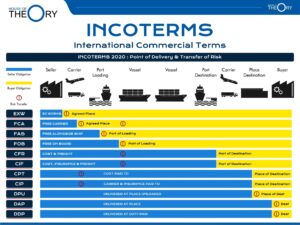
The current edition of incoterms is INCO 2020. There are 11 incoterms in total, and they are grouped into four categories:
The E Term
EXW
EXW is the only E term. It stands for “Ex Works”.
This term is used exclusively to refer to transactions where the seller, exporter, or manufacturer makes the goods available at their own premises. This means that the buyer takes on all subsequent risks, responsibilities, and costs for the goods’ ongoing journey to the final point of delivery.
The F Terms
These terms apply to transactions where the seller or exporter is responsible to deliver the goods to a carrier.
Usually, the buyer arranges for the carrier, meaning that the buyer and the seller share risks and costs. The seller handles the risks and costs up to the handover, and the buyer handles the risks and costs for the rest of the process.
There are three F terms:
FCA (Free carrier)
The delivery point is an agreed location, such as a port or a terminal.
FAS (Free Alongside Ship)
This term refers exclusively to marine shipping. The delivery point is a port of shipment, and the risk and cost transfer takes place when the goods are placed alongside the ship.
FOB (Free On Board)
Another marine shipping incoterm. Like FAS, the delivery point is a port of shipment, but this time the risk and cost of transfer takes place when the goods are loaded onboard the ship.
The C Terms
These terms apply to transactions where the seller, exporter, or manufacturer takes responsibility for arranging for, and paying for, the carriage of goods. However, they are not responsible for any additional risks or costs that may emerge once the goods have been shipped.
There are four C terms:
CPT (Carriage Paid To)
The delivery point is a named place of destination, and the seller is responsible for all transport costs until the goods are handed to the first carrier.
CIP (Carriage and Insurance Paid To)
The delivery point is a named place of destination, and the seller is responsible for all risks and costs until the goods are handed to the first carrier. In this case, the costs include some insurance cover for any loss or damage to the goods during that first part of their journey.
CFR (Cost and freight)
This term refers exclusively to marine shipping. The delivery point is the port of destination, and the seller is responsible for all freight costs up to the point where the goods are onboard the ship.
CIF (Cost, Insurance, and Freight)
Another marine shipping term. The delivery point is the port of destination, and the seller is responsible for all freight costs up to the point where the goods are onboard the ship. But they will also pay for insurance, to cover any loss or damage to the goods during that first part of their journey.
The D Terms
These terms apply to transactions where the seller, exporter, or manufacturer takes responsibility for all costs and risks associated with delivering goods to a named place of destination.
There are three D terms:
DAP (Delivered At Place)
The buyer specifies a delivery point, and the seller is responsible for all costs and risks associated with delivering the goods to this destination. However, this does not extend to any costs or risks associated with unloading the goods, or taking them to a further destination.
DPU (Delivered At Place, Unloaded)
The buyer specifies a delivery point, and the seller is responsible for all costs and risks associated with delivering the goods to this destination. This time, the seller takes additional responsibilities for the costs and risks associated with unloading the goods at the destination.
DDP (Delivered Duty Paid)
The buyer specifies a delivery point, and the seller is responsible for all costs and risks associated with delivering the goods to this destination. In this case, these costs will include any duties incurred during the delivery.
Why Incoterms Matter for Liability
Each incoterm clarifies both the buyer’s and the seller’s responsibilities when it comes to both costs and risks. The terms also clarify the limits of these responsibilities, and the point at which they might transfer from one party to another.
Get incoterms right, and it can lead to streamlined global shipping, even when there is no shared language. But get them wrong, and it can lead to delays, extra costs, custom issues, and even legal disputes.
This is why it is important to not just choose the right incoterm for each transaction, but also to ensure that the contract reflects the implications of the term you use. For example, most incoterms require a named destination. If this is not included in the contract, it could lead to ambiguities and disagreements should anything go wrong.
How Incoterms Affect Insurance
The incoterms you use during your transactions will also determine the level of insurance cover you need, whether you are the buyer or the seller.
In an EXW transaction, the buyer takes on the most risk. In a DDP transaction, the seller takes on the most risk. Other incoterms will require the buyer and the seller to share the risks and the costs, with the specific code determining the precise point at which the responsibilities transfer from one party to another.
Whichever code you use, it is essential that your insurance covers you for all the risks and responsibilities as outlined in your contract.
Everard Insurance Brokers are the specialist marine trading division of accredited Lloyd’s brokers James Hallam Limited. We can help you understand the cost, risk, and insurance implications of any incoterm you use, and we can help you get the specialist cover you need at a competitive price.